Book Review: Following Jesus in a Warming World
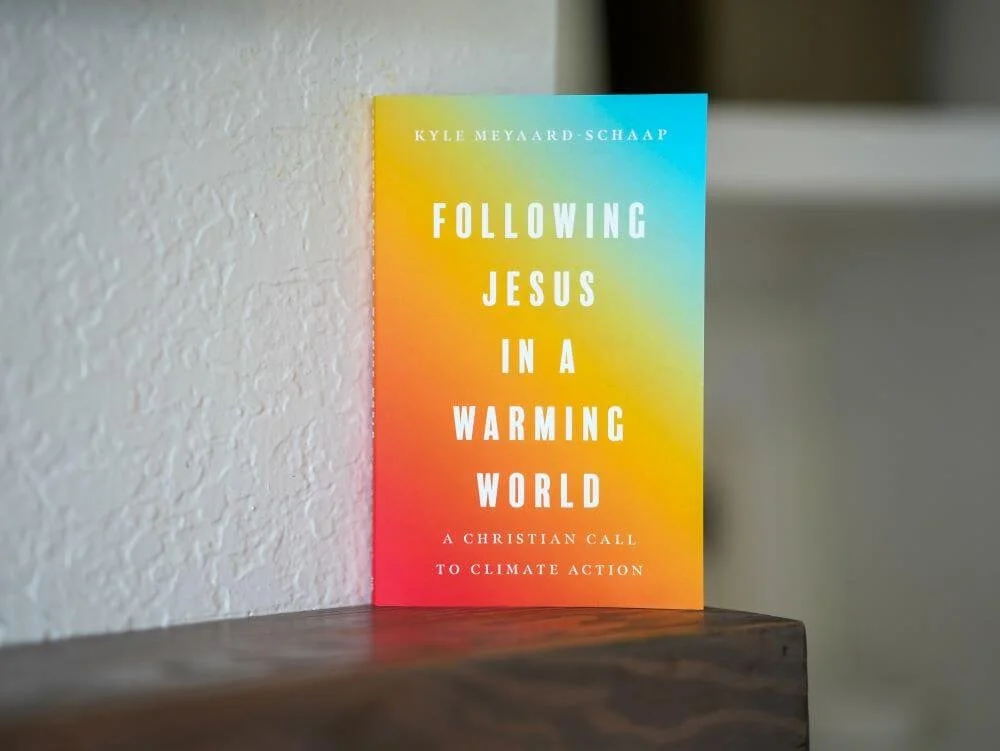
For a class I’m taking on environmental rhetoric, I was asked to write a book review identifying how an author successfully delivered their argument. What a joy it is that I can use Festival books for my class assignments!
Reverend Kyle Meyaard-Schaap establishes a compelling case for Christians responding to climate change in Following Jesus in a Warming World: A Christian Call to Climate Action. In this 2023 book, he presents an understanding of climate justice informed by story-telling and love of God and neighbor above all else. Meyaard-Schaap masterfully accomplishes this by drawing from his own experiences, considering and writing for his specifically-Christian audience, and equipping his readers to take action in the wider world.
The book begins with the end of the world for a younger Meyaard-Schaap: his beloved brother becomes a vegetarian. He describes this as almost a betrayal, viewing his brother as “totally different—someone I didn’t recognize.” In many ways, this book is a product of that experience. By sharing his initial reaction—which prompted further considerations of how humans interact with the wider environment—in contrast to what he has since learned, Meyaard-Schaap invites readers in, epitomizing the change in perspective that is available to those who wish to seriously reflect on how their faith is lived out. This allows readers to feel comfortable being challenged, since the author himself has embodied this. In this introduction, Meyaard-Schaap displayes the value of open-mindedness in practice, adequately preparing readers for the development of his argument.
After providing some background information on the climate crisis, Meyaard-Schaap, as a pattern, places readers right in the action. His variety and use of stories plays witness to his extensive experience involved in climate conversations. These strengthen his argument, both by highlighting his credibility in the field and framing the problem of climate change in a uniquely personal way. For instance, Meyaard-Schaap describes a visit to West Virginia, where mountaintop-removal coal mining has obliterated communities. Here, he meets Larry, the final property-owner on a mountain a local company has their hearts set on using. While intimidation tactics by men hired by the local company have succeeded in convincing neighbors to sell their property, Larry has withstood harassing, stalking, and having his house shot at so as to preserve his environment. Here, the inclusion of Larry’s struggles provides readers a new understanding of the severity of the problem they may not have encountered before. In sharing countless other anecdotes along the way—ranging from a woman in Kenya unable to sustain her family due to changing seasonal patterns to a man losing everything in Hurricane Katrina—Meyaard-Schaap emphasizes that everyone has a story, and these stories matter. People are impacted by climate change in unimaginable ways, and Meyaard-Schaap’s next step is to deem it crucial for Christians especially to hear and be affected by these stories.
In centering Scripture and Christian conversation topics throughout his book, Meyaard-Schaap identifies and successfully engages his audience. In chapter two, he details oversimplifications or misconceptions of ideas that have assisted the convergence of the political right and the American evangelical church, and thus impacted the common Christian understanding of climate change; he labels them stories that have formed us, harmfully, instead of the Bible. These are then contrasted in the following chapter with readings of Scripture passages. While chapters like Genesis 1 and 2 may be familiar to his church-going audiences, Meyaard-Schaap casts them all in a new light, aiming to display, “God’s deep and abiding love for all His Creation, our special role of responsibility in the midst of it, and His intentions—through Jesus—to bring all of it back to himself once more.” By being rooted in the Bible, Meyaard-Schaap earns more credibility to support his argument for why Christians ought to be responding to climate change: it follows Jesus’ renewal of the entirety of the world. He also aims to expand “pro-life” rhetoric to include supporting the lives of people adversely affected by climate change, especially communities of color, instead of merely applying to “pro-birth” commitments in abortion contexts. Not explicitly weighing in on the topic of abortion itself, Meyaard-Schaap successfully escapes the partisan trap while still indicating why climate change is harmful for our neighbors and embracing difficult conversations about the application of people’s faith. Conversations surrounding climate change can also be hard, and Meyaard-Schaap acknowledges that in his introduction, as he plainly states his book is “for every Christian who has looked out at a world ravaged by the impacts of climate change, at the inability of their seemingly oblivious faith community to do or say something about it, and quietly wondered if they’re losing their mind.” In conveying this sentiment, he rescues readers who have felt alone, uses the Bible to unify them into a larger community, and indicates they are in the right place to move forward in response.
Once he has engaged his audience, Meyaard-Schaap equips them to act our climate justice in their own way. Because he is overtly focused on how stories harm or help us, his path to action begins by talking about it. In the same way that he shared other peoples’ stories to humanize the problem of climate change, Meyaard-Schaap recognizes the power to personally connect with whomever you are interacting with. This process involves listening as much as speaking, and it is useful to “find something you both care about, connect the dots to how climate change is already affecting what you both care about… share a constructive solution that you can both agree on” and then invite the other to act on those solutions. Meyaard-Schaap offers a sample of one possible conversation, in which an uncle and nephew discuss their love of fly fishing but their sadness at declining salmon populations. By providing a hypothetical situation as a guide, he supplies readers with a successful example to reference, which is a useful application tool in an otherwise somewhat-abstract suggestion. To the same end, there are a multitude of recommendations for taking other forms of action, including scripts for calling Congresspeople, advice for writing op-eds, and suggestions to reimagine climate action as spiritual disciplines. In including such a variety, Meyaard-Schaap inspires readers to live out their Christian commitments to their own ability, expertly allowing for people’s particularities and gifts to guide them.
Instead of feeling burdened by guilt and responsibility, it should be a joy to help do Kingdom-work.
Meyaard-Schaap relies on the feelings of joy and hope produced from engaging in climate action. Because he links climate justice as part of God’s redemption of Creation, he views it as good news for the alleviation of our neighbors’ sufferings and thus a worthy effort. Instead of feeling burdened by guilt and responsibility, it should be a joy to help do Kingdom-work. However this assumes the effectiveness of collective action. Meyaard-Schaap encourages readers to depolarize climate change by having conversations about it as well as suggesting actions for small-scale individuals or groups to take. Since individuals are not the major causes of climate change, his approach may not be the most productive to solving climate change, and it would require a lot of public buy-in to be successful.
But Meyaard-Schaap is not attempting to solve climate change; he aims to motivate Christians to live out their faith, practicing their love of God—who Created and will restore His Creation—and neighbor—especially those impacted by climate change—in how they consider their relationship to the environment. He achieves this through story-telling, both his own and God’s. His anecdotes illustrate the harm to humans that may be overlooked in ecological perspectives of climate change, correctly anticipating who our neighbors are. In also remaining embedded in Scripture, Meyaard-Schaap reminds readers about the greatest commandment, to love God and these neighbors. He additionally equips readers with many options for taking action depending on their strengths. Following Jesus in a Warming World is a successful guide to reinvigorating a commitment to God through climate action.